
Motorcycle Salvage Parts UK: How to Find the Right Components
Introduction
Finding replacement motorcycle components can become expensive, especially when a bike has suffered accident damage or needs several parts at the same time. Brand-new components can be costly, and some parts for older or discontinued motorcycles may be difficult to find.
This is where Motorcycle Salvage Parts UK can provide a useful and affordable alternative.
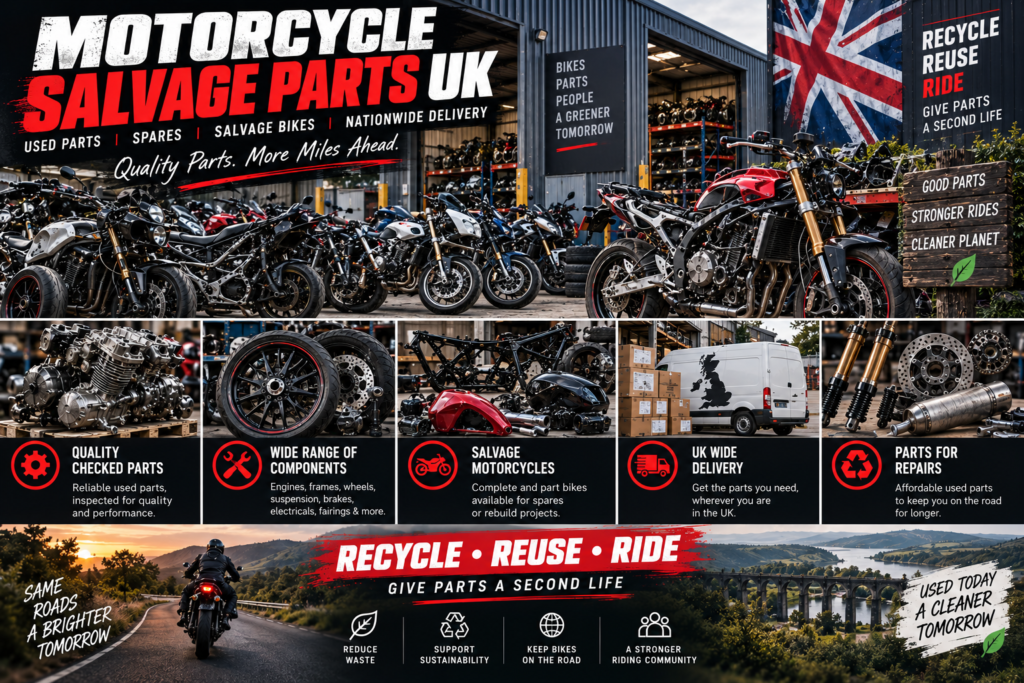
Salvage motorcycles are often dismantled so that usable components can be recovered and sold separately. These parts can include everything from fairings and wheels to engine components, electrical parts, exhausts and suspension components.
For riders repairing damaged bikes, maintaining older motorcycles or working on restoration projects, salvage parts can provide access to genuine components at potentially lower prices.
However, buying salvage parts requires careful attention. The cheapest part is not always the best choice, and compatibility, condition and safety should always be considered.
This guide explains how Motorcycle Salvage Parts UK work, how to find the right components and what to check before buying.
What Are Motorcycle Salvage Parts UK?
Motorcycle Salvage Parts UK are used components recovered from motorcycles that are no longer being kept in complete working condition.
A donor motorcycle may have been:
- Damaged in an accident
- Declared uneconomical to repair
- Written off
- Retired from road use
- Purchased specifically for dismantling
- Stored as a source of replacement components
Rather than discarding the entire motorcycle, usable parts can be removed and made available for reuse.
This creates an extensive second-hand parts market for riders looking for affordable replacements.
Depending on availability, salvage parts can include:
- Engine components
- Bodywork
- Wheels
- Suspension
- Exhausts
- Controls
- Electrical components
- Frames and subframes
- Braking components
- Seats and accessories
Why Buy Motorcycle Salvage Parts UK?
There are several reasons riders consider salvage components.
Lower Repair Costs
One of the main attractions is affordability.
Used salvage parts are often available for less than equivalent new components. This can make repairs more manageable, particularly when a motorcycle has suffered extensive damage.
Instead of replacing an entire assembly with new parts, you may be able to source only the individual components that need replacing.
Genuine Motorcycle Components
Salvage parts can provide access to original manufacturer components removed from another motorcycle.
For some repairs, an original used component may be preferable to an aftermarket alternative, especially when trying to maintain factory fitment or appearance.
Hard-to-Find Parts
Older motorcycles can become difficult to maintain when manufacturers stop producing certain parts.
Salvage suppliers and motorcycle breakers can sometimes provide components that are no longer widely available as new replacements.
This can be particularly useful for:
- Classic motorcycles
- Older Japanese bikes
- Discontinued models
- Rare variants
- Restoration projects
Useful for Accident Repairs
Salvage parts can be particularly valuable after an accident.
A damaged motorcycle may need several cosmetic or mechanical components at once, and purchasing all of them new can become expensive.
Used fairings, panels, wheels, brackets and other suitable components can help reduce the repair bill.
10 Essential Tips for Finding the Right Motorcycle Salvage Parts UK
1. Identify Your Exact Motorcycle
The first step is knowing precisely which motorcycle you have.
Record:
- Manufacturer
- Model
- Engine size
- Model year
- Generation
- Variant
- VIN where appropriate
This information is essential because parts can change between model years.
A component that fits one version of a motorcycle may not fit another even when the bikes look almost identical.
2. Find the Correct Part Number
The original part number can make the search much easier.
Where possible, locate the part number on your existing component and compare it with the salvage replacement.
A matching part number can provide a useful indication that the component is intended for the same application.
If the number is unavailable, provide the seller with your exact motorcycle details and ask them to confirm compatibility.
3. Check the Condition Carefully
Salvage parts come from motorcycles with different histories.
Some components may have relatively little wear, while others may have been exposed to heavy use or impact.
Ask:
Has the part been inspected?
Has it been tested?
Does it have any damage?
Has it previously been repaired?
Is anything missing?
Do not assume that a used component is ready to install simply because it looks clean.
4. Ask for Photos of the Actual Component
Photos can be extremely useful when buying Motorcycle Salvage Parts UK.
Ask to see the actual part rather than relying solely on a generic product image.
Inspect photographs for:
- Cracks
- Bends
- Corrosion
- Scratches
- Broken mounts
- Missing fasteners
- Impact marks
- Previous repairs
Bodywork should be assessed for both structural and cosmetic condition.
5. Find Out About the Donor Bike
Information about the donor motorcycle can sometimes help you evaluate a component.
Where available, ask about:
- Donor model
- Model year
- Mileage
- Accident history
- Reason for dismantling
- Previous running condition
The history does not guarantee the condition of a particular part, but it can give you additional context.
6. Check Whether Electrical Parts Have Been Tested
Electrical components can be difficult to evaluate visually.
If you are buying items such as:
- Starter motors
- Sensors
- Regulators
- Instrument clusters
- Switchgear
- Control units
- Charging components
ask whether they have been tested.
A visually clean electrical component may still have an internal fault.
7. Compare Total Cost
Do not compare parts based only on their advertised price.
Calculate:
Part price + delivery + fitting + refurbishment
A cheaper component may need significant additional work before it can be used.
A slightly more expensive part that is already inspected or in better condition may offer better overall value.
8. Check the Return Policy
Used and salvage parts can sometimes be difficult to identify correctly without seeing them in person.
Before ordering, find out what happens if:
- The wrong part is supplied
- The component does not fit
- The part arrives damaged
- The component is faulty
- The item does not match its description
A clear return policy can reduce the risk of an unsuitable purchase.
9. Consider Safety Before Price
Not every component should be purchased purely because it is cheap.
Pay particular attention to:
- Brake components
- Wheels
- Steering parts
- Suspension components
- Frames
- Handlebars
- Structural parts
These components can directly affect motorcycle safety.
Where condition is uncertain, professional inspection is advisable before installation.
10. Choose a Reliable Salvage Supplier
The supplier can make a major difference to your experience.
A reputable motorcycle salvage specialist should provide useful information about:
- Compatibility
- Condition
- Availability
- Testing
- Delivery
- Returns
Clear communication is particularly important when purchasing large or expensive components.
Which Motorcycle Salvage Parts Are Commonly Available?
The available stock will depend on the donor motorcycles and the supplier, but a wide range of components can be found.
Engine Salvage Parts
Potentially available engine components include:
- Engine covers
- Cylinder heads
- Crankcases
- Clutch components
- Gearbox parts
- Starter motors
- Alternators
- Oil pumps
- Water pumps
- Engine assemblies
Mechanical parts should be assessed carefully for wear and damage.
Bodywork Salvage Parts
Bodywork is one of the most popular categories because new panels can be expensive.
You may find:
- Fairings
- Side panels
- Mudguards
- Tail sections
- Seats
- Fuel tanks
- Covers
For cosmetic components, ask for detailed photos showing scratches, cracks and colour condition.
Wheel and Suspension Components
Potential salvage components include:
- Front wheels
- Rear wheels
- Forks
- Fork legs
- Rear shocks
- Swingarms
- Linkage components
These parts require extra care because bends, impact damage or excessive wear may not always be immediately obvious.
Electrical Salvage Parts
Electrical components can include:
- Instrument clusters
- Switchgear
- Wiring components
- Sensors
- Relays
- Starter motors
- Control units
- Charging components
Correct compatibility and testing are particularly important.
Exhaust Salvage Parts
Used exhaust systems can provide a lower-cost replacement option.
Before buying, inspect for:
- Cracks
- Dents
- Heavy corrosion
- Damaged brackets
- Broken mounting points
Motorcycle Salvage Parts UK for Older Motorcycles
Older motorcycles are particularly well suited to the salvage parts market.
As manufacturers discontinue components, sourcing brand-new replacements can become difficult.
Salvage specialists may have suitable parts removed from donor motorcycles that match the original design.
This makes Motorcycle Salvage Parts UK useful for:
- Classic bikes
- Older Japanese motorcycles
- Discontinued models
- Rare motorcycles
- Long-term restoration projects
A genuine used part can sometimes be a better match than a modern aftermarket alternative.
Motorcycle Salvage Parts UK for Restoration Projects
Restoration often requires original-looking components.
A restored motorcycle may need:
- Original bodywork
- Genuine engine components
- Period-correct controls
- Original brackets
- Wheels
- Exhaust components
- Instruments
Buying every component new can make restoration prohibitively expensive.
Salvage parts can provide a practical way to source genuine used components while keeping costs more manageable.
For restoration work, cosmetic condition should be assessed separately from mechanical condition.
A small scratch may be acceptable on an original component if the goal is authenticity, while a structural crack would be a much more serious concern.
Motorcycle Salvage Parts UK for Dirt Bikes
Dirt bike riders can also benefit from salvage components.
Off-road motorcycles are exposed to demanding riding conditions, making replacement parts an important part of ownership.
Depending on availability, salvage suppliers may stock:
- Engine parts
- Plastics
- Fork components
- Wheels
- Swingarms
- Subframes
- Exhausts
- Controls
- Footrests
- Clutch parts
Exact model and year information is particularly important because dirt bike specifications can change between generations.
Are Motorcycle Salvage Parts Reliable?
Salvage parts can be reliable when they are correctly identified and carefully assessed.
However, the condition of every used component is different.
Before purchasing, consider:
Age + mileage + previous use + damage + testing + compatibility
A part with low wear and proper inspection may provide excellent value.
A heavily damaged or poorly documented component may not be worth the risk even if the purchase price is low.
Condition should always be evaluated based on what the part is designed to do.
Used Salvage Parts vs New Motorcycle Parts
| Factor | Motorcycle Salvage Parts | New Motorcycle Parts |
|---|---|---|
| Purchase price | Usually lower | Usually higher |
| Condition | Varies | New |
| Availability | Depends on donor stock | Often more predictable |
| Older models | Often useful | May be discontinued |
| Genuine components | Frequently available | Depends on manufacturer |
| Warranty | Depends on supplier | Usually stronger |
| Restoration projects | Excellent option | Can be expensive |
| Cosmetic condition | Varies | New |
Neither option is automatically right for every repair.
The best choice depends on the component, budget, motorcycle and required condition.
How to Search for the Right Salvage Component
A clear search or parts enquiry can save a lot of time.
Instead of searching only for:
“Yamaha fairing”
provide:
“Yamaha [exact model] [engine size] [year] right-side fairing”
The more specific your information, the easier it is for a supplier to identify the correct component.
For complex components, include the original part number whenever possible.
Common Mistakes When Buying Motorcycle Salvage Parts
Choosing Only the Cheapest Part
A cheap component can become expensive if it needs extensive refurbishment.
Ignoring Model-Year Differences
Parts can change between generations.
Not Checking the Part Number
A part that looks similar may still be incompatible.
Buying Without Seeing Condition
Ask for actual photographs where possible.
Ignoring Damage History
Previous impact damage may affect structural components.
Forgetting Delivery Costs
Large parts can be expensive to transport.
Buying Safety-Critical Components Without Proper Checks
Safety should always come before price.
How to Save Money With Motorcycle Salvage Parts UK
The best savings come from making an informed purchase.
Start by identifying exactly what you need, then compare different suppliers and condition levels.
Consider the total cost rather than just the listing price.
For larger repairs, it may also be useful to source multiple compatible components from the same supplier, potentially reducing delivery costs.
Keeping your original damaged component until the replacement arrives can also help you compare dimensions, connectors and mounting points.
What Questions Should You Ask a Salvage Parts Supplier?
Before buying, ask:
Is this the exact part for my model and year?
What is the part number?
Has it been tested?
What condition is it in?
Does it have any cracks, bends or corrosion?
Was it removed from a running motorcycle?
Are all mounting points and hardware included?
What is the return policy?
How much will delivery cost?
These questions can help you avoid common second-hand parts problems.
Final Verdict: How to Find the Right Motorcycle Salvage Parts UK
Motorcycle Salvage Parts UK can be an excellent solution for riders looking for affordable replacement components, genuine used parts or difficult-to-find items.
The biggest advantages are lower purchase costs, access to original components and greater availability for older or discontinued motorcycles.
However, buying salvage parts requires careful checking.
Always confirm your exact motorcycle model, compare part numbers, inspect condition, ask about testing, calculate delivery and fitting costs and understand the return policy before purchasing.
For cosmetic and many non-critical components, salvage parts can provide excellent value. For brakes, steering, suspension and other safety-critical components, condition and professional inspection should take priority over price.
Looking for the Right Motorcycle Salvage Parts?
Start with your motorcycle’s exact make, model, year and part number. Then choose a reputable supplier that can provide clear condition information and suitable compatibility guidance. With careful research, Motorcycle Salvage Parts UK can help you complete repairs and restoration projects at a more manageable cost.
FAQs About Motorcycle Salvage Parts UK
What are Motorcycle Salvage Parts UK?
Motorcycle Salvage Parts UK are used components recovered from motorcycles that are being dismantled. They can include engine parts, bodywork, wheels, suspension, electrical components and exhausts.
Are motorcycle salvage parts cheaper than new parts?
They are often cheaper than equivalent new components, although the actual saving depends on the part, condition, rarity and availability.
Can I find genuine motorcycle parts from salvage bikes?
Yes. Salvage motorcycles can provide genuine manufacturer components removed from donor bikes.
Are motorcycle salvage parts reliable?
They can be reliable when properly inspected and suitable for the intended motorcycle. Condition varies between individual components.
How do I know if a salvage part will fit my motorcycle?
Confirm the exact manufacturer, model, engine size and model year. Compare the original part number with the replacement where possible.
Can I buy motorcycle salvage engine parts?
Yes. Depending on availability, salvage suppliers may have engine covers, cylinder heads, crankcases, clutch parts, gearbox components and other engine-related parts.
Are salvage bodywork parts worth buying?
They can be an affordable way to replace damaged fairings, panels, mudguards and other cosmetic components. Always check photographs and cosmetic condition.
Should I buy used wheels or suspension parts?
These components require careful inspection for bends, cracks, corrosion and excessive wear. Professional inspection can be appropriate when condition is uncertain.
Can I find old motorcycle parts through salvage suppliers?
Yes. Salvage parts can be particularly useful for discontinued, older and rare motorcycles where new components may be difficult to source.
Are Motorcycle Salvage Parts UK suitable for restoration?
Yes. Genuine used components can be valuable for restoring classic, older and discontinued motorcycles while keeping the project cost under control.
Can I buy dirt bike salvage parts?
Yes. Depending on stock, salvage suppliers may have used dirt bike plastics, engine parts, wheels, suspension components, exhausts and controls.
What should I check before buying salvage motorcycle parts?
Check compatibility, part number, condition, damage, testing, donor-bike information, delivery cost and return terms before purchasing.
Do motorcycle salvage parts come with a warranty?
Warranty arrangements vary between suppliers and parts. Always check the seller’s terms before ordering.
Is a cheap motorcycle salvage part always good value?
No. A low purchase price does not necessarily mean good value. Consider condition, refurbishment, fitting and delivery costs before making your decision.