
Motorcycle Dismantlers UK: How the Process Works
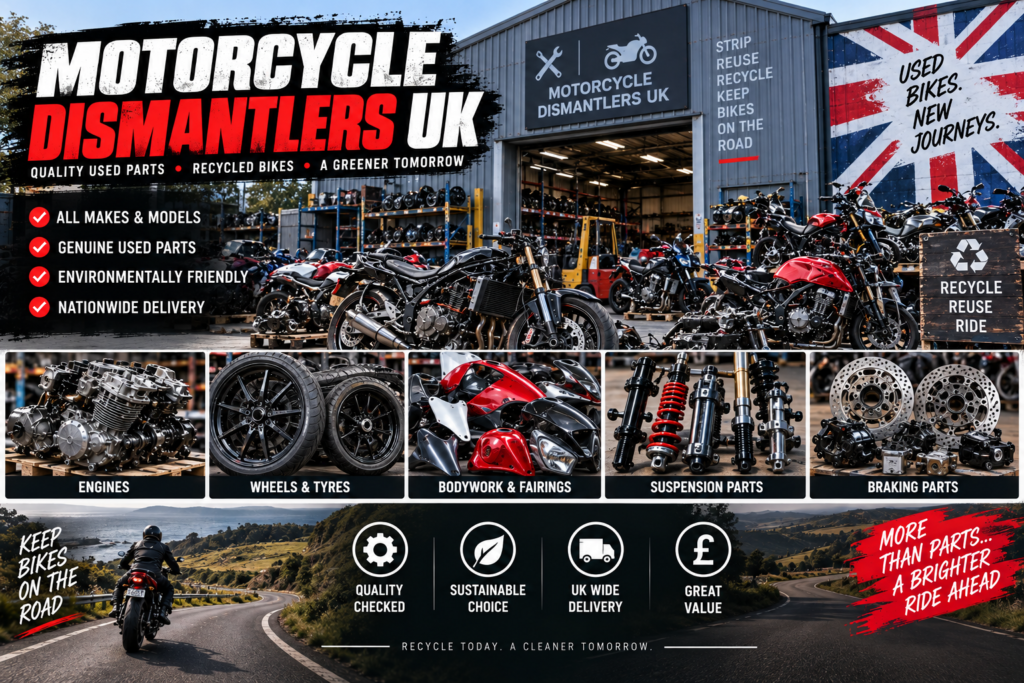
Introduction
When a motorcycle reaches the end of its useful life, suffers serious accident damage or becomes too expensive to repair, the entire bike does not necessarily need to go to waste.
This is where Motorcycle Dismantlers UK play an important role.
Motorcycle dismantlers carefully take bikes apart and recover components that may still be suitable for reuse. These parts can then be inspected, tested, catalogued and sold to riders looking for affordable replacement components.
From engine parts and wheels to fairings, electrical components and exhausts, dismantling can give useful motorcycle components a second life.
For riders, the process can provide access to genuine used parts at potentially lower prices than buying new components.
But how exactly does motorcycle dismantling work?
This guide explains the complete process, what happens to a motorcycle after it reaches a dismantler and how buyers can benefit from the used motorcycle parts market.
What Are Motorcycle Dismantlers UK?
Motorcycle Dismantlers UK are specialist businesses that take motorcycles apart to recover reusable components.
The motorcycle may be dismantled because it has:
- Been involved in an accident
- Been declared uneconomical to repair
- Become too old to maintain economically
- Been acquired specifically for parts
- Developed major mechanical problems
- Reached the end of its road life
Instead of treating the motorcycle as a single item, dismantlers separate it into individual components.
Usable parts can then be inspected, stored and made available to customers.
This helps create a circular market where components that would otherwise be discarded can be reused on other motorcycles.
How Does Motorcycle Dismantling Work?
The process involves several stages.
A professional dismantler does more than simply remove parts from a motorcycle.
The process typically involves:
Motorcycle sourcing → assessment → dismantling → inspection → testing → cleaning → cataloguing → storage → sale
Each stage contributes to the quality and usefulness of the resulting used parts.
10 Powerful Steps in the Motorcycle Dismantling Process
1. Sourcing the Donor Motorcycle
The first stage is obtaining a motorcycle that is suitable for dismantling.
A donor motorcycle may come from:
- Accident-damaged bikes
- Insurance-related salvage
- Older motorcycles
- Unwanted project bikes
- Non-running motorcycles
- Bikes purchased specifically for dismantling
The condition of the donor motorcycle helps determine which components may be suitable for resale.
A heavily damaged motorcycle may still contain many usable parts even if it is not economical to repair as a complete bike.
2. Initial Motorcycle Assessment
Once the motorcycle arrives, it can be assessed to identify potentially reusable components.
The dismantler may examine:
- Engine condition
- Frame
- Wheels
- Suspension
- Bodywork
- Electrical components
- Exhaust
- Braking system
- Controls
- Accessories
This assessment helps determine which parts have commercial value and which components should not be reused.
For accident-damaged bikes, particular attention is paid to areas that may have experienced impact.
3. Identifying Reusable Components
Not every part removed from a motorcycle is automatically suitable for resale.
The dismantler must determine whether individual components appear appropriate for reuse.
Potentially reusable components can include:
- Engine covers
- Clutch components
- Starter motors
- Alternators
- Wheels
- Fairings
- Seats
- Switchgear
- Instruments
- Exhaust parts
- Fork components
- Brackets
Safety-critical and structural parts require particularly careful assessment.
4. Careful Dismantling
The motorcycle is then taken apart systematically.
Components are removed in a controlled manner to reduce unnecessary damage.
Careful dismantling can help preserve mounting points, connectors, fasteners and other small components that may be needed by the eventual buyer.
A professional approach also makes it easier to identify which parts belong to which motorcycle.
5. Inspection and Condition Assessment
After removal, components can be examined individually.
The condition check may look for:
- Cracks
- Bends
- Corrosion
- Excessive wear
- Impact damage
- Broken mounting points
- Missing components
- Previous repairs
The condition of a used part should be described accurately so that buyers understand what they are purchasing.
A cosmetic component with scratches is very different from a mechanical component with serious wear.
6. Testing Mechanical and Electrical Components
Some components need more than visual inspection.
Mechanical and electrical parts may require appropriate testing to determine whether they function correctly.
Potentially testable parts include:
- Starter motors
- Alternators
- Switchgear
- Instrument clusters
- Sensors
- Pumps
- Electrical control components
Testing can help distinguish between parts that are suitable for resale and components that should be rejected or sold only for non-operational purposes where appropriate.
7. Cleaning and Preparation
Used motorcycle parts are often cleaned before being stored or sold.
Cleaning can help:
- Reveal damage
- Improve presentation
- Remove dirt and oil
- Make part numbers easier to identify
- Allow more accurate photography
Cleaning does not mean a part is refurbished or mechanically rebuilt.
Buyers should still ask about testing, wear and condition.
8. Cataloguing the Parts
Once components have been inspected and prepared, they need to be organised.
A professional dismantler may record information such as:
- Motorcycle make
- Model
- Year
- Engine size
- Part name
- Part number
- Condition
- Quantity
- Storage location
Accurate cataloguing makes it easier to find the correct component when a customer is searching for a specific part.
9. Safe Storage
Storage is another important part of the dismantling process.
Components should be organised in a way that protects them from unnecessary damage.
Small electrical parts need different storage requirements from large body panels or engines.
Good organisation also helps prevent:
- Lost components
- Incorrect part identification
- Damage during handling
- Packaging mistakes
For buyers, accurate storage and cataloguing can contribute to a smoother ordering process.
10. Selling the Used Motorcycle Parts
The final stage is making suitable components available to customers.
Depending on the dismantler, parts may be sold through:
- Online listings
- Direct enquiries
- Telephone orders
- Parts departments
- Collection services
- Delivery services
Customers can search for the exact motorcycle part they require and confirm compatibility before purchasing.
This completes the process from donor motorcycle to reusable replacement component.
Why Are Motorcycle Dismantlers UK Important?
Motorcycle dismantlers provide value to both riders and the wider parts market.
Affordable Replacement Parts
Used components can often cost less than equivalent new parts.
This can make repairs more manageable, particularly for older motorcycles.
Access to Genuine Components
Dismantlers can provide original manufacturer parts removed from donor motorcycles.
This can be useful when riders want to retain original specifications.
Hard-to-Find Parts
Older and discontinued motorcycles can be difficult to support with new parts.
Dismantlers may have components available from donor bikes that are no longer commonly produced.
Reduced Waste
Recovering usable components gives parts another useful life instead of sending every motorcycle component for disposal.
Support for Restoration Projects
Classic and restoration projects often require original components that are no longer easily available.
Motorcycle dismantlers can therefore be a valuable source of restoration parts.
What Parts Can You Buy From Motorcycle Dismantlers UK?
The range varies according to the motorcycles being dismantled.
Engine Components
Potentially available parts include:
- Engine covers
- Cylinder heads
- Crankcases
- Clutch components
- Gearbox parts
- Starter motors
- Alternators
- Oil pumps
- Water pumps
- Complete engines
Mechanical condition should always be checked carefully.
Bodywork
Used bodywork can include:
- Fairings
- Side panels
- Mudguards
- Tail units
- Seats
- Fuel tanks
- Covers
This is particularly useful after accident damage.
Suspension Components
Possible parts include:
- Forks
- Fork legs
- Rear shocks
- Springs
- Swingarms
- Linkage components
These should be carefully assessed for bends, corrosion and wear.
Wheels and Brakes
Dismantlers may have:
- Front wheels
- Rear wheels
- Brake discs
- Calipers
- Master cylinders
- Levers
These are safety-critical components, so buyers should pay close attention to their condition.
Electrical Components
Potential parts include:
- Instrument clusters
- Switchgear
- Sensors
- Wiring components
- Relays
- Starter motors
- Charging components
- Control units
Compatibility is particularly important with electrical parts.
Exhaust Components
Used exhaust parts can be useful when replacing damaged systems.
Check carefully for:
- Cracks
- Heavy corrosion
- Dents
- Damaged brackets
- Broken mounting points
Motorcycle Dismantlers UK for Older Motorcycles
Older motorcycles can benefit significantly from dismantling services.
A manufacturer may stop producing certain parts after many years, making replacement components harder to find.
A dismantler may still have suitable parts from donor motorcycles.
This can be especially helpful for:
- Classic motorcycles
- Older Japanese bikes
- Discontinued models
- Rare variants
- Restoration projects
A genuine used component can sometimes be preferable to modifying the motorcycle to accept an aftermarket replacement.
Motorcycle Dismantlers UK for Dirt Bikes
Dirt bike owners can also benefit from specialist dismantling.
Off-road bikes can experience heavy wear due to demanding riding environments.
Depending on available stock, dismantlers may supply:
- Engine parts
- Plastics
- Wheels
- Fork components
- Swingarms
- Subframes
- Exhausts
- Footrests
- Controls
- Clutch components
Exact model and year information is important because off-road motorcycle components can differ significantly between generations.
How to Buy the Right Part From a Motorcycle Dismantler
Buying from Motorcycle Dismantlers UK becomes much easier when you provide complete motorcycle details.
Include:
Make + model + engine size + year + exact component + part number
For example, instead of requesting:
“Yamaha fairing”
provide the exact motorcycle model, model year, side of the motorcycle and relevant part number if available.
This reduces confusion and helps the dismantler identify the correct component.
What Should You Check Before Buying?
Before ordering a used part, ask about:
Compatibility
Will the component fit your exact motorcycle?
Condition
Does it have cracks, corrosion, bends or excessive wear?
Testing
Has the component been tested where appropriate?
Part Number
Does the part number match your motorcycle’s required specification?
Photos
Can you see the actual component?
Return Policy
What happens if the component is incorrect or faulty?
Delivery
What is the total cost of getting the part to you?
These questions can prevent many common second-hand parts problems.
Are Parts From Motorcycle Dismantlers Reliable?
Used motorcycle components can be reliable when they have been correctly identified, inspected and assessed.
However, condition varies from part to part.
A component from a lightly used donor bike may have plenty of useful service life remaining.
Another part may already have significant wear.
For this reason, evaluate:
Age + mileage + condition + testing + previous use + compatibility
Do not assume that every part from a dismantler is automatically ready to install.
Safety-Critical Motorcycle Parts
Some components require greater caution than others.
Be especially careful with:
- Brakes
- Wheels
- Steering parts
- Suspension
- Frames
- Handlebars
- Structural components
A used cosmetic panel and a brake component should not be treated in the same way.
If the condition of a safety-critical part is uncertain, professional inspection should be considered before use.
Motorcycle Dismantlers UK vs Buying New Parts
| Factor | Motorcycle Dismantlers UK | New Motorcycle Parts |
|---|---|---|
| Purchase price | Usually lower | Usually higher |
| Condition | Varies | New |
| Availability | Depends on donor stock | Often predictable |
| Older models | Often useful | May be discontinued |
| Genuine components | Frequently available | Depends on manufacturer support |
| Warranty | Depends on supplier | Usually stronger |
| Restoration projects | Excellent option | Can be expensive |
| Cosmetic condition | Varies | New |
The right choice depends on the part, motorcycle, budget and required condition.
Motorcycle Dismantlers UK and Recycling
Dismantling can also support a more efficient use of motorcycle components.
Instead of treating a damaged or unwanted motorcycle as a single waste item, useful components can be recovered and reused.
Metal and other materials that cannot be reused as working parts can also be separated as part of an appropriate recycling process.
This means dismantling can support both the used-parts market and responsible end-of-life handling.
Common Mistakes When Buying From Motorcycle Dismantlers UK
Buying Only Because the Price Is Low
A low-cost component may require expensive refurbishment.
Ignoring the Part Number
Visual similarity does not guarantee compatibility.
Forgetting Model-Year Changes
Components can change between generations.
Not Asking About Condition
Always understand whether the part has been tested and inspected.
Ignoring Safety
Safety-critical components deserve additional attention.
Forgetting Delivery Costs
Large components can be expensive to transport.
Not Checking Returns
Know your options if the part is unsuitable.
How to Get Better Value From Motorcycle Dismantlers UK
The best way to save money is to compare the whole purchase rather than the advertised price.
Consider:
Part price + delivery + fitting + refurbishment
A slightly more expensive part in better condition may provide stronger value than the cheapest available component.
It can also be useful to ask whether different condition levels are available.
For restoration projects, sourcing multiple compatible components from the same dismantler may also help simplify the buying process.
Final Verdict: How the Motorcycle Dismantling Process Works
Motorcycle Dismantlers UK play an important role in providing affordable used components for riders, restoration specialists and motorcycle repair businesses.
The process begins with sourcing a donor motorcycle and assessing its condition. Suitable parts are then carefully removed, inspected, tested where appropriate, cleaned, catalogued and stored before being offered for sale.
This process gives useful motorcycle components another opportunity to serve a purpose while helping riders access genuine parts at potentially lower prices.
When buying from a dismantler, always confirm compatibility, check condition, compare part numbers, ask about testing and understand the return and delivery terms.
For cosmetic and many non-critical components, used parts can provide excellent value. For brakes, steering, suspension and other safety-critical components, condition and professional inspection should take priority.
Looking for Quality Used Motorcycle Parts?
Choose a reputable Motorcycle Dismantlers UK supplier, provide your exact motorcycle information and ask detailed questions about the component before purchasing. With careful checking, dismantlers can be an excellent source of affordable, genuine and hard-to-find motorcycle parts.
FAQs About Motorcycle Dismantlers UK
What are Motorcycle Dismantlers UK?
Motorcycle Dismantlers UK are specialists who take motorcycles apart and recover usable components for resale, reuse and recycling.
Why do motorcycles get dismantled?
Motorcycles may be dismantled because they are accident-damaged, uneconomical to repair, older, unwanted or acquired specifically for parts.
What parts can motorcycle dismantlers sell?
Depending on their stock, dismantlers may sell engine parts, bodywork, wheels, suspension, electrical components, exhausts, controls, seats and many other motorcycle components.
Are motorcycle dismantler parts cheaper?
Used parts are often less expensive than new equivalents, although prices vary according to condition, rarity, demand and availability.
Can I find parts for old motorcycles?
Yes. Motorcycle dismantlers can be particularly useful for finding discontinued and hard-to-source components for older bikes.
Can Motorcycle Dismantlers UK supply dirt bike parts?
Yes. Depending on available donor motorcycles, dismantlers may have used dirt bike engine parts, plastics, wheels, suspension components, exhausts and controls.
Are used motorcycle parts reliable?
They can be reliable when they are suitable for the motorcycle and have been properly inspected or tested. Condition varies between individual components.
How do I make sure a dismantler’s part will fit?
Provide the exact motorcycle make, model, engine size, year and part number where available. Ask the dismantler to confirm compatibility before ordering.
Should I buy used brake or suspension components?
These parts can be safety-critical and require careful inspection. If condition is uncertain, professional assessment before installation is recommended.
Do motorcycle dismantlers sell genuine manufacturer parts?
Yes. Because components are removed from existing motorcycles, dismantlers can often supply genuine manufacturer parts as used components.
Are Motorcycle Dismantlers UK useful for restoration?
Yes. They can provide original and discontinued components that may be difficult or expensive to source new, making them useful for restoration projects.
Do motorcycle dismantlers offer delivery?
Many suppliers can arrange delivery, but availability and costs depend on the business and size of the component.
Can I return a used motorcycle part?
Return policies vary between suppliers. Always check the seller’s terms before placing an order.
Are Motorcycle Dismantlers UK environmentally useful?
Dismantling allows suitable components to be reused and can help separate materials for appropriate recycling, reducing the amount of a motorcycle that needs to be discarded as a whole.