
Used vs New Motorcycle Parts: Which Is Better?
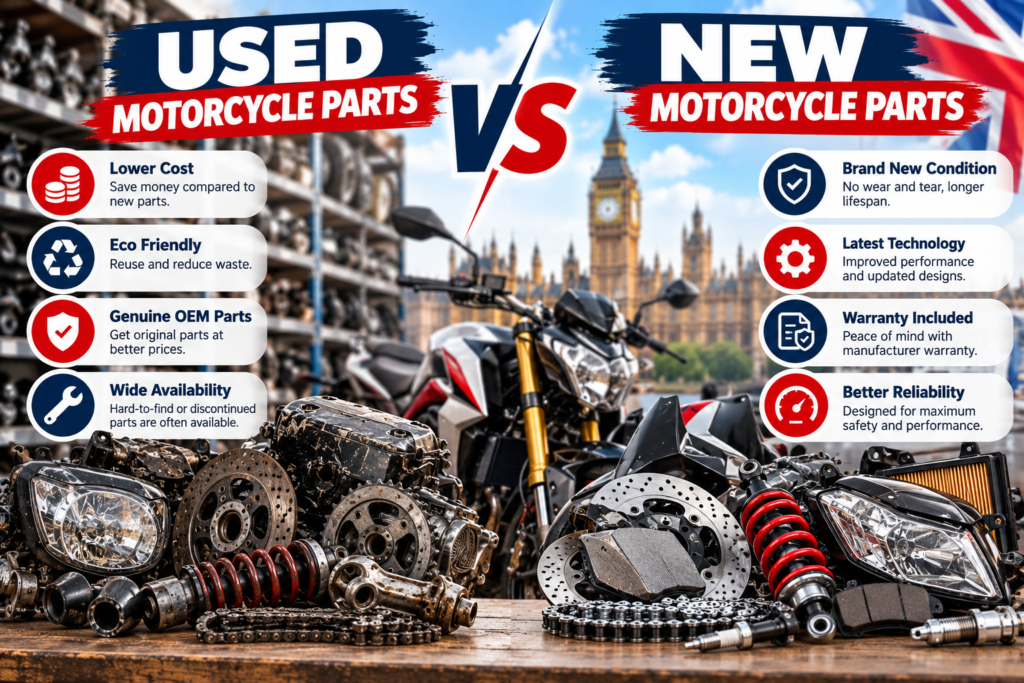
Replacing motorcycle parts can become expensive, particularly when repairing an older bike, restoring a classic motorcycle or maintaining a machine that needs several components.
This often leaves riders asking an important question: Used vs New Motorcycle Parts, which is better?
The answer depends on the motorcycle, the component, your budget, the condition of the used part and how important the part is to safety and reliability.
Used motorcycle parts can provide excellent value, especially when buying genuine manufacturer components or discontinued parts. New motorcycle parts, meanwhile, offer the advantage of being unused, with predictable condition and, depending on the supplier, stronger warranty support.
Neither option is automatically better for every situation.
This guide compares Used vs New Motorcycle Parts across price, condition, reliability, availability, compatibility, safety and long-term value to help UK motorcycle owners make a more informed decision.
What Are Used Motorcycle Parts?
Used motorcycle parts are components removed from previously owned, damaged, salvaged or dismantled motorcycles.
They can include:
- Engines
- Gearboxes
- Wheels
- Fairings
- Exhausts
- Suspension components
- Electrical parts
- Engine covers
- Clutch components
- Seats
- Controls
- Brackets
- Bodywork
A used part may come from a motorcycle that was damaged in an accident but still had many components suitable for reuse.
For older motorcycles, used parts can also provide access to genuine components that are no longer available new.
What Are New Motorcycle Parts?
New motorcycle parts are unused components manufactured or supplied specifically for replacement or repair.
They can be:
OEM parts
Aftermarket parts
Performance parts
Replacement service components
New parts can be purchased from motorcycle manufacturers, dealers, specialist suppliers and online retailers.
Their main advantage is predictable condition because they have not previously been installed and used on another motorcycle.
Used vs New Motorcycle Parts: 10 Key Differences
1. Purchase Price
Price is usually the first difference riders notice when comparing Used vs New Motorcycle Parts.
Used components are often less expensive than equivalent new parts.
This can make them attractive when repairing an older motorcycle or replacing multiple components.
New parts generally cost more, particularly when purchasing genuine OEM components.
However, price should never be the only factor.
A cheaper used component that needs refurbishment may ultimately cost more than a slightly more expensive new part.
Best choice for price:
Used parts usually win.
2. Condition
New motorcycle parts have not previously been used, so their condition is predictable.
A used part has a history.
Its condition can depend on:
- Motorcycle age
- Mileage
- Previous owner
- Riding conditions
- Maintenance
- Accident history
- Storage
- Previous repairs
This makes inspection particularly important when buying used.
Best choice for predictable condition:
New parts win.
3. Availability
Availability can depend heavily on the motorcycle.
For current models, new parts may be relatively easy to source.
For older or discontinued motorcycles, the situation can be completely different.
A manufacturer may stop producing a particular component, while a motorcycle breaker may still have the original part available from a donor bike.
This makes used parts particularly valuable for:
- Classic motorcycles
- Older Japanese bikes
- Discontinued models
- Rare variants
- Restoration projects
Best choice for older or discontinued parts:
Used parts can win.
4. Original Manufacturer Components
One advantage of buying used is the possibility of finding genuine original components.
For example, a motorcycle breaker may have the exact original fairing, bracket, switchgear or engine cover removed from another motorcycle.
This can be useful for restoration projects where maintaining the original specification matters.
New parts can also be genuine OEM components, but they may be unavailable for older motorcycles.
Best choice for discontinued genuine components:
Used parts can be the better option.
5. Warranty and Returns
New motorcycle parts generally provide more predictable warranty and return options, although the exact terms depend on the supplier.
Used parts may also come with warranties or returns, but policies vary considerably between breakers and sellers.
Before buying used, check:
Return period
Warranty period
Fault policy
Compatibility policy
Delivery damage procedure
Never assume that every used component comes with the same protection as a new part.
Best choice for stronger standard warranty support:
New parts usually win.
6. Reliability
Reliability is more complicated than simply asking whether a component is used or new.
A high-quality used original part that has been carefully inspected may be more reliable than a poor-quality new aftermarket component.
Likewise, a new OEM component will normally provide a high level of confidence in its specification and condition.
The key factors are:
Manufacturer
Quality
Condition
Compatibility
Installation
Expected service life
Best choice:
It depends on the specific part and quality.
7. Safety
Safety should be one of the most important factors in the Used vs New Motorcycle Parts decision.
Some components deserve much greater caution when buying second-hand.
These include:
- Brake components
- Tyres
- Wheels
- Frames
- Steering components
- Suspension components
- Handlebars
- Critical fasteners
For these parts, condition and structural integrity are extremely important.
If the history of a used safety-critical component is uncertain, buying new may provide greater confidence.
Best choice for maximum condition confidence:
New parts generally have the advantage.
8. Restoration Projects
Restoration projects are one situation where used parts can be especially valuable.
A restoration may require genuine components that are no longer manufactured.
A used original panel, instrument cluster, exhaust component or engine cover may help preserve the motorcycle’s original appearance.
New aftermarket alternatives may be available, but they may not match the original design.
Best choice for many restoration projects:
Used parts can be extremely useful.
9. Environmental Considerations
Used parts provide an opportunity to reuse components that are already in circulation.
Instead of manufacturing a completely new component, a suitable used part can be removed from a donor motorcycle and installed on another machine.
Motorcycle dismantlers can also recover materials from motorcycles that are no longer economical to repair.
This can support reuse and reduce unnecessary waste.
New parts still have an important role, particularly when safety, reliability or availability makes replacement the better option.
Best choice for component reuse:
Used parts have an advantage.
10. Long-Term Value
The cheapest option isn’t necessarily the best long-term investment.
When comparing Used vs New Motorcycle Parts, consider the total cost:
Purchase price + delivery + fitting + refurbishment + future replacement
A £50 used component may look attractive, but if it requires £75 of refurbishment, the real cost is £125.
A £100 new component may therefore offer better value.
On the other hand, a £40 used original component that is ready to install could be an excellent purchase compared with an expensive new replacement.
Used vs New Motorcycle Parts Comparison Table
| Factor | Used Motorcycle Parts | New Motorcycle Parts |
|---|---|---|
| Purchase price | Usually lower | Usually higher |
| Condition | Varies | Predictable |
| Warranty | Seller dependent | Usually stronger |
| Availability for older bikes | Often excellent | May be limited |
| Genuine discontinued parts | Often available | May be unavailable |
| Safety confidence | Requires inspection | Generally easier to assess |
| Restoration projects | Excellent | Can be expensive |
| Custom projects | Useful | Wide aftermarket choice |
| Environmental reuse | Strong advantage | Requires new manufacturing |
| Long-term value | Depends on condition | Often predictable |
The best choice depends on the individual component and motorcycle.
When Should You Buy Used Motorcycle Parts?
Used parts can make sense when:
You’re Repairing an Older Motorcycle
Older bikes may have discontinued components that are difficult to source new.
You’re Restoring a Motorcycle
Genuine used parts can help preserve original appearance and specification.
The Part Is Cosmetic
Fairings, panels and brackets can often be good second-hand purchases when properly inspected.
You Want to Reduce Repair Costs
Used parts can lower the overall cost of a repair.
A Genuine OEM Part Is Available Used
A quality used original component may be preferable to an unknown aftermarket replacement.
When Should You Buy New Motorcycle Parts?
New parts are often the better option when:
The Component Is Safety-Critical
Brakes, tyres and other critical components deserve particular attention.
The Part Experiences High Mechanical Stress
Some heavily stressed engine or suspension components may be better purchased new or professionally inspected.
You Need Maximum Reliability
A new OEM component can provide predictable condition and specification.
The Used Part Has an Unknown History
If you cannot establish how a component was used or maintained, buying new can reduce uncertainty.
A New Part Is Reasonably Priced
If the price difference between used and new is small, the additional confidence of a new component may be worth the extra cost.
Which Motorcycle Parts Are Good to Buy Used?
Several categories can provide good value when purchased second-hand.
Bodywork
Used fairings, side panels and mudguards can be excellent purchases.
Inspect for cracks and damaged mounting points.
Engine Covers
Used clutch covers, alternator covers and other external engine covers can be economical replacements.
Exhausts
Used exhaust components can offer significant savings, provided they are free from serious corrosion or structural damage.
Electrical Components
Switchgear, instruments and some electrical components can be suitable when tested and confirmed compatible.
Wheels
Used wheels can save money but require careful inspection for bends, cracks and impact damage.
Suspension Components
Used forks and shocks may be suitable when their condition is verified, but leaks, bends and wear need to be checked carefully.
Which Parts Should Usually Be Bought New?
There is no universal rule, but new components can be preferable for certain safety-critical or highly stressed applications.
Consider buying new for:
Tyres
Brake pads
Critical brake components
Some seals and gaskets
Certain fasteners
Highly stressed internal engine components
Components with unknown used history
The correct decision depends on the exact component and manufacturer’s requirements.
OEM vs Aftermarket vs Used Parts
There are actually three common choices.
| Option | Main Advantage | Main Consideration |
|---|---|---|
| New OEM | Original specification | Higher cost |
| New aftermarket | Choice and pricing | Quality varies |
| Used OEM | Lower cost and original component | Condition varies |
This is why the decision isn’t always simply Used vs New Motorcycle Parts.
Sometimes the best choice is a high-quality used OEM part.
In other cases, a new aftermarket component may offer better value.
For safety-critical components, quality and correct specification should take priority over price.
How to Check a Used Motorcycle Part Before Buying
If you decide to buy used, follow a basic checklist.
Confirm Compatibility
Check:
Make
Model
Year
Engine size
Variant
Part number
Ask About Condition
Find out:
- Has the part been tested?
- Was it removed from a running motorcycle?
- Does it have damage?
- Has it been repaired?
- How much wear does it have?
Request Actual Photos
Look for:
- Cracks
- Corrosion
- Bends
- Scratches
- Damaged mounting points
- Previous repairs
Check the Return Policy
Understand what happens if the part is incorrect or faulty.
Compare Total Cost
Consider:
Part + delivery + fitting + refurbishment
This gives you a more realistic comparison with a new component.
How to Compare Used vs New Motorcycle Parts Prices
Don’t compare only the advertised price.
For example:
Used part: £60
Delivery: £15
Refurbishment: £25
Total: £100
Compared with:
New part: £120
Delivery: £10
Total: £130
In this example, the used component still saves £30.
But if refurbishment increases the used part’s total to £135, the new component may actually provide better value.
This simple calculation can prevent false bargains.
Used vs New Motorcycle Parts for Dirt Bikes
Dirt bike owners often deal with heavy wear and frequent replacement requirements.
Used parts can be useful for:
- Plastics
- Wheels
- Subframes
- Exhausts
- Engine covers
- Controls
- Footrests
- Some suspension components
However, dirt bike components can vary significantly between model years.
Always check exact compatibility before purchasing.
Used vs New Motorcycle Parts for Classic Bikes
Classic motorcycles are another area where used parts can be extremely valuable.
Manufacturers may no longer produce many original components.
A motorcycle breaker or dismantler may have an original component from another bike that is difficult to source elsewhere.
For restoration projects, preserving original parts can be more important than simply purchasing the cheapest replacement.
Common Mistakes to Avoid
Buying Only on Price
The cheapest component isn’t necessarily the best value.
Ignoring Compatibility
Similar-looking parts can have completely different specifications.
Buying Safety-Critical Parts Without Inspection
Brakes, wheels, steering and suspension require extra care.
Forgetting Delivery Costs
Large motorcycle components can be expensive to transport.
Ignoring Refurbishment Costs
A used component may require cleaning, rebuilding or repair.
Assuming New Always Means Better
A poor-quality aftermarket component isn’t automatically better than a high-quality used OEM part.
Assuming Used Always Means Cheap
Rare or highly desirable used components can sometimes be expensive because availability is limited.
Clear Buying Call to Action
Trying to decide between Used vs New Motorcycle Parts for your next repair?
Start by identifying the exact component and checking its importance to vehicle safety.
Compare a reputable used part with a new OEM or quality aftermarket alternative based on price, condition, compatibility, warranty and expected service life.
For used components, choose a reputable motorcycle breaker or dismantler that provides accurate descriptions, actual photos and clear return terms.
Compare your options today and choose the motorcycle part that offers the best combination of quality, safety and value.
Final Verdict: Used vs New Motorcycle Parts
So, Used vs New Motorcycle Parts — which is better?
There is no single answer.
Used motorcycle parts can be an excellent choice when you’re looking for lower prices, genuine OEM components, discontinued parts or restoration items.
New motorcycle parts offer predictable condition, stronger warranty potential and greater confidence when the component is safety-critical or highly stressed.
The smartest approach is to choose according to the specific part, rather than deciding that all used or all new components are better.
For bodywork, brackets, engine covers, some electrical components and restoration parts, quality used components can offer excellent value.
For tyres, critical brakes and other safety-sensitive components, buying new can often provide greater confidence.
Ultimately, the best motorcycle part is the one that provides the right balance of quality, compatibility, safety, reliability and total cost.
FAQs About Used vs New Motorcycle Parts
Which is better, used or new motorcycle parts?
Neither is universally better. Used parts can offer lower prices and access to genuine or discontinued components, while new parts provide predictable condition and generally stronger warranty support.
Are used motorcycle parts reliable?
They can be reliable when properly inspected and compatible with the motorcycle. Condition varies between individual components.
Are new motorcycle parts always better?
No. A high-quality used OEM component can sometimes be a better option than a low-quality new aftermarket part.
Are used motorcycle parts cheaper?
They are often cheaper, although the saving depends on condition, rarity, availability and demand.
Which motorcycle parts should I buy new?
Safety-critical components such as tyres and many brake components are often better purchased new, particularly when the history of a used part is uncertain.
Which motorcycle parts are good to buy used?
Bodywork, engine covers, brackets, some electrical components and certain exhaust or restoration parts can provide good value when properly inspected.
Are used motorcycle wheels safe?
They can be, but wheels should be checked carefully for cracks, bends, impact damage and corrosion. Professional inspection is advisable if there is any uncertainty.
Are used motorcycle engines worth buying?
They can be worthwhile for project bikes and older motorcycles, but condition, mileage, compression, service history and compatibility should be investigated.
Is it better to buy used OEM or new aftermarket?
It depends on the component and manufacturer. Compare the used OEM part’s condition with the quality and specifications of the new aftermarket alternative.
Where can I buy used motorcycle parts in the UK?
Used parts are available through motorcycle breakers, dismantlers, salvage specialists, specialist online suppliers and some local motorcycle businesses.
How do I know if a used part fits my motorcycle?
Check the exact make, model, year, engine size, variant and part number. Ask the seller to confirm compatibility before buying.
Do used motorcycle parts come with a warranty?
Some do, but warranty terms vary between suppliers. Always check the seller’s conditions before purchasing.
Are new motorcycle parts worth the extra money?
They can be, particularly when you need predictable condition, warranty support or maximum confidence for a safety-critical component.
Are used parts good for classic motorcycle restoration?
Yes. Genuine used components can be particularly valuable for restoring older motorcycles where original parts are discontinued or difficult to source.
Can used motorcycle parts save money?
Yes. They can reduce repair costs, especially when buying genuine components that are expensive or unavailable new.