
How to Choose Right Used Motorcycle Part
10 Essential Tips for UK Buyers
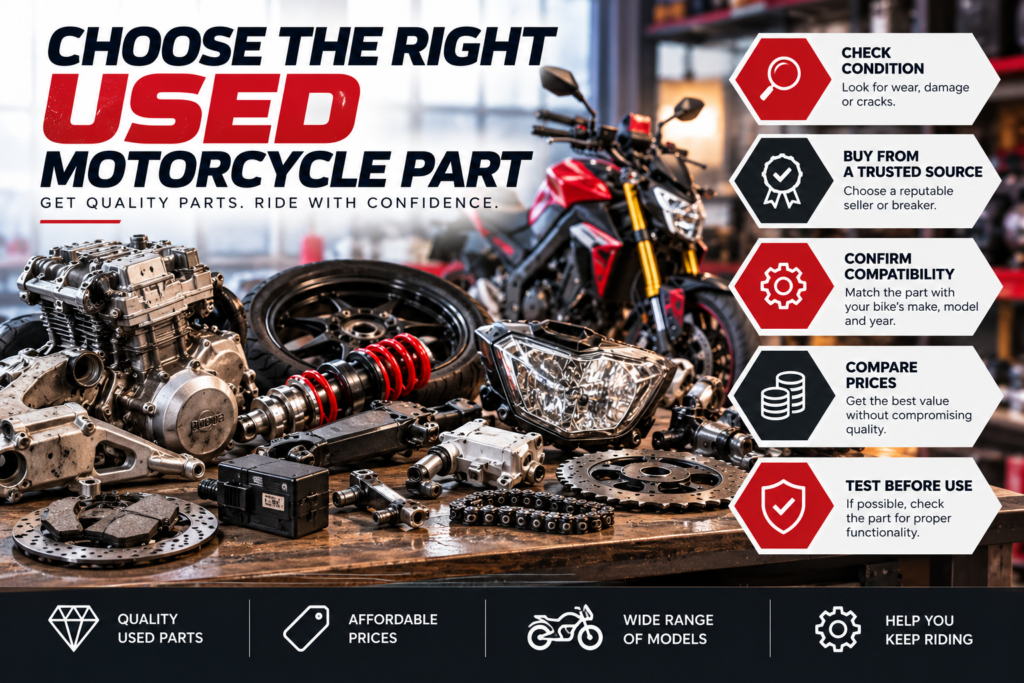
Buying used motorcycle parts can be an excellent way to reduce repair costs, maintain an older bike or find components that are no longer available as new. However, choosing the wrong part can lead to wasted money, compatibility problems and unnecessary repair delays.
Knowing how to Choose Right Used Motorcycle Part options is especially important when buying from motorcycle breakers, dismantlers and second-hand parts suppliers across the UK.
Whether you need an engine component, gearbox, wheel, fairing, exhaust or electrical part, you should check more than the price. Compatibility, condition, part numbers, seller reputation and return policies all matter.
In this guide, we explain how to choose suitable used motorcycle parts, what to inspect before buying and how to get better value without compromising safety.
Why Choose Right Used Motorcycle Part?
Used motorcycle parts can be a practical alternative to new components, particularly when repairing older motorcycles or working within a limited budget.
1. Save Money on Repairs
Used components are often less expensive than equivalent new parts. The actual saving depends on the part’s condition, availability, age and demand.
For example, a used fairing or engine cover may offer a more affordable replacement than purchasing a new original component.
2. Find Discontinued Parts
Some motorcycle manufacturers stop producing parts for older models. Motorcycle breakers may still have suitable components removed from donor bikes.
This can be particularly helpful for restoration projects and motorcycles that are difficult to support with new parts.
3. Access Genuine Manufacturer Components
Used parts can include original equipment manufacturer (OEM) components. These may be useful when you want to maintain your motorcycle’s original specification.
However, genuine parts still need to be checked for wear, damage and compatibility.
4. Reduce Unnecessary Waste
Reusing suitable motorcycle components can extend their useful life and reduce the need to manufacture replacements. Parts that are damaged or unsuitable for reuse should be handled through appropriate recycling or disposal channels.
How to Choose Right Used Motorcycle Part: 10 Essential Checks
Follow these steps before ordering from a motorcycle breaker or second-hand parts supplier.
1. Identify Your Exact Motorcycle
The first step is to identify your motorcycle accurately. Do not rely on the manufacturer’s name or engine capacity alone.
Check the following details:
- Motorcycle make
- Exact model
- Model year
- Engine capacity
- Model generation or variant
- VIN or chassis details, where relevant
- Original part number, if available
Two motorcycles with similar names or appearances may use different components. Even a small change between model years can affect fitment.
Providing complete information helps the seller identify a suitable replacement and reduces the risk of ordering the wrong part.
2. Check the Original Choose Right Used Motorcycle Part Number
The original part number is one of the most useful ways to confirm compatibility.
If possible, locate the number on your existing component or in the manufacturer’s parts catalogue. Compare it with the number provided by the seller for Choose Right Used Motorcycle Part.
A matching part number can provide strong evidence of compatibility, although you should still confirm whether the part has been superseded or whether the manufacturer specifies an alternative.
If the number is missing, ask the seller to verify fitment using your exact motorcycle details.
3. Inspect the Part’s Condition
A used part may look suitable in a photograph but still have damage that affects its usefulness.
Ask for clear pictures of the actual component and check for:
- Cracks or fractures
- Bends or distortion
- Corrosion
- Excessive wear
- Damaged threads
- Broken mounting points
- Missing fasteners
- Signs of previous repairs
The inspection should reflect the type of component. Cosmetic scratches on a fairing are different from cracks in a structural part.
If you cannot inspect the component in person, request additional photographs and an honest description of any defects.
4. Ask About the Donor Motorcycle
Understanding where a used part came from can help you assess its condition.
Ask the seller:
- What model and year was the donor motorcycle?
- Was it running before dismantling?
- Why was it dismantled?
- Was it involved in an accident?
- Has the component been tested?
- Does it have any known faults?
- Has it been repaired or refurbished?
A part removed from an accident-damaged motorcycle is not automatically unusable, but any component that may have experienced an impact deserves particular scrutiny.
Do not assume that a part is fully functional simply because it came from a running bike.
5. Confirm Exactly What Is Included
Some used parts are supplied as complete assemblies, while others are sold individually.
For example, a used engine may not include every electrical component, fuel-system part or external fitting needed for installation. A fairing listing may exclude brackets, clips or mounting hardware.
Before paying, confirm:
- The exact component being sold
- Whether related parts are included
- Whether fasteners or brackets are supplied
- Whether connectors or wiring are attached
- Whether the item needs refurbishment
- Whether the photographs show everything included
This helps you calculate the real cost rather than relying only on the advertised price.
6. Choose a Reputable Motorcycle Breaker
A reliable seller should provide clear descriptions, accurate photographs and useful information about compatibility.
When researching UK motorcycle breakers, look for:
- Transparent business details
- Clear product descriptions
- Responsive communication
- Honest condition reports
- Written returns and warranty terms
- Secure payment options
- Appropriate packaging and delivery arrangements
Customer reviews can provide additional insight, but consider the details of the feedback rather than relying on ratings alone.
A professional seller should be willing to answer reasonable questions before you place an order.
7. Compare the Total Cost
The cheapest listing is not always the best value.
Calculate the likely total cost, including:
Part price + delivery + fitting + refurbishment + any additional components
A cheaper part may require extensive repairs or extra hardware, while a slightly more expensive component may be ready for installation.
Compare parts with similar specifications and condition. This makes it easier to judge whether a deal represents genuine value.
8. Check the Return Policy and Warranty
Before buying, understand what happens if the part arrives damaged, proves faulty or is not compatible with your motorcycle.
Check:
- Whether returns are accepted
- The deadline for reporting a problem
- Whether the seller offers a warranty
- Who pays return postage
- Whether restocking charges apply
- What evidence is required for a faulty-part claim
Terms vary between sellers and types of purchase. UK consumer rights may also depend on whether you buy from a business or a private individual and how the transaction takes place.
Read the terms before paying, and keep your order confirmation and correspondence.
9. Consider Whether Buying Used Is Appropriate
Not every motorcycle component is a good candidate for second-hand purchase.
Used bodywork, covers, brackets and some non-critical components may be reasonable options when condition and compatibility are clear.
However, safety-critical components require greater care.
Pay particular attention to:
- Braking components
- Steering components
- Wheels and tyres
- Suspension components
- Frames and structural parts
- Handlebars and critical mounting hardware
Hidden damage may not be visible in photographs. For these components, professional inspection may be necessary, and a new part can be the safer choice when condition or history is uncertain.
10. Check the Part Before Installation
Your checks should not stop when the parcel arrives.
Before fitting the component:
- Compare it with the original part.
- Confirm part numbers and dimensions.
- Check for transport damage.
- Inspect mounting points and connectors.
- Verify that all required components are present.
- Confirm that the part is suitable for the intended application.
If anything differs from the seller’s description or raises safety concerns, do not install it until the issue has been resolved.
Which Used Motorcycle Parts Can You Buy?
The availability of used parts depends on the motorcycles held by individual breakers.
Used Engine Parts
Possible components include engine covers, cylinder heads, crankcases, clutch components, starter motors and other engine-related parts.
Internal engine components need careful assessment because wear may not be visible externally. Ask about testing and previous use before purchasing.
Used Gearboxes and Transmission Parts
Gearbox components can be expensive to replace new. Before buying a used gearbox or internal transmission part, confirm the exact engine version, model year and compatibility.
Ask about known faults and the seller’s testing process.
Used Wheels and Suspension
Wheels, forks, rear shocks and linkage components may be available from dismantlers.
Check for cracks, bends, leaks, corrosion and damaged mounting points. Because these components can affect handling and safety, professional inspection is advisable if their history is uncertain.
Used Fairings and Bodywork
Fairings, side panels, mudguards, seats and other bodywork are popular second-hand purchases.
Check colour, finish, mounting tabs, cracks and whether all required clips or brackets are included.
Used Electrical Components
Switchgear, instruments, sensors, starter motors and charging-system components may be available.
Verify the part number, connector type and electrical specification. For electronic control units, compatibility and any required programming should be confirmed before buying.
Used Motorcycle Parts vs New Parts
| Factor | Used parts | New parts |
|---|---|---|
| Purchase price | Often lower | Usually higher |
| Condition | Depends on previous use | Unused |
| Availability | Depends on breaker stock | Depends on supplier and manufacturer |
| Older motorcycles | Can help source discontinued parts | Some parts may no longer be available |
| Warranty | Depends on seller and terms | Often includes manufacturer or seller cover |
| Inspection | Previous condition must be assessed | Less concern about previous use |
The right option depends on the component, your budget, the availability of replacements and the level of confidence you need in its condition.
Common Mistakes to Avoid When Choose Right Used Motorcycle Part
Buying Based Only on Appearance
Parts can look identical but have different dimensions, connectors or mounting points. Verify compatibility rather than relying on photographs alone.
Ignoring Model-Year Differences
A component from a similar motorcycle may not fit your exact model year.
Assuming Every Part Has Been Tested
Ask the seller what inspections or tests have actually been carried out.
Forgetting Delivery and Fitting Costs
A low advertised price can become less attractive once delivery, repairs and installation are included.
Overlooking Safety
Never compromise on the condition of braking, steering, suspension or structural components just to save money.
Final Verdict: How to Choose Right Used Motorcycle Part
Knowing how to Choose Right Used Motorcycle Part options can help you save money, maintain your motorcycle and find components for older or discontinued models.
Start by identifying your exact bike and checking the original part number. Then assess the component’s condition, ask about its history, confirm what is included and choose a seller with clear terms.
Most importantly, consider the type of component you are buying. Cosmetic and non-critical parts may be suitable second-hand purchases when inspected properly, while safety-critical components deserve more rigorous checks and professional assessment.
Looking for the Right Used Motorcycle Part?
Contact a reputable UK motorcycle breaker with your motorcycle’s make, model, year, engine capacity and part number. Ask for photographs of the actual component, confirmation of compatibility and details of the returns policy before ordering.
Choose the right replacement part, compare the total cost and check compatibility before you buy to make your next motorcycle repair more straightforward.
FAQs About Choose Right Used Motorcycle Part
How do I Choose Right Used Motorcycle Part?
Identify your exact motorcycle, compare the original part number, inspect the component’s condition and confirm compatibility with the seller before purchasing.
How do I know if a used motorcycle part will fit?
Check the make, model, model year, variant and part number. If the part number is unavailable, ask the seller to verify compatibility using your motorcycle details.
Are used motorcycle parts reliable?
They can be reliable when correctly matched to the bike and appropriately inspected or tested. Condition varies, so ask about wear, faults, previous repairs and warranty terms.
Is it cheaper to Choose Right Used Motorcycle Part?
Used components are often cheaper than new equivalents, but compare the total cost, including delivery, fitting and any refurbishment that may be needed.
Should I buy used motorcycle engine parts?
Some used engine components can be suitable, but their condition and history should be checked carefully. Internal components may require specialist inspection or testing.
Are used motorcycle brakes safe to buy?
Braking components are safety-critical. Their condition must be assessed carefully, and professional inspection is advisable if there is any uncertainty. A new component may be the safer choice.
Can I return a used motorcycle part if it does not fit?
That depends on the seller’s terms and the circumstances of the purchase. Check the returns policy before paying and retain your order records.
Where can I find used motorcycle parts in the UK?
You can look at motorcycle breakers, dismantlers and specialist used-parts suppliers. Compare their descriptions, compatibility information, delivery arrangements and customer service before ordering.
What information should I give a motorcycle breaker?
Provide the motorcycle’s make, exact model, year, engine capacity and the part number if available. Photographs of your existing component may also help the seller identify a suitable replacement.
Are OEM used motorcycle parts better than aftermarket parts?
OEM parts can help maintain the original specification, but a used OEM component may have wear or damage. Compare condition, compatibility, quality and cost before deciding.