
Breaking Motorcycles for Parts: How UK Breakers Work
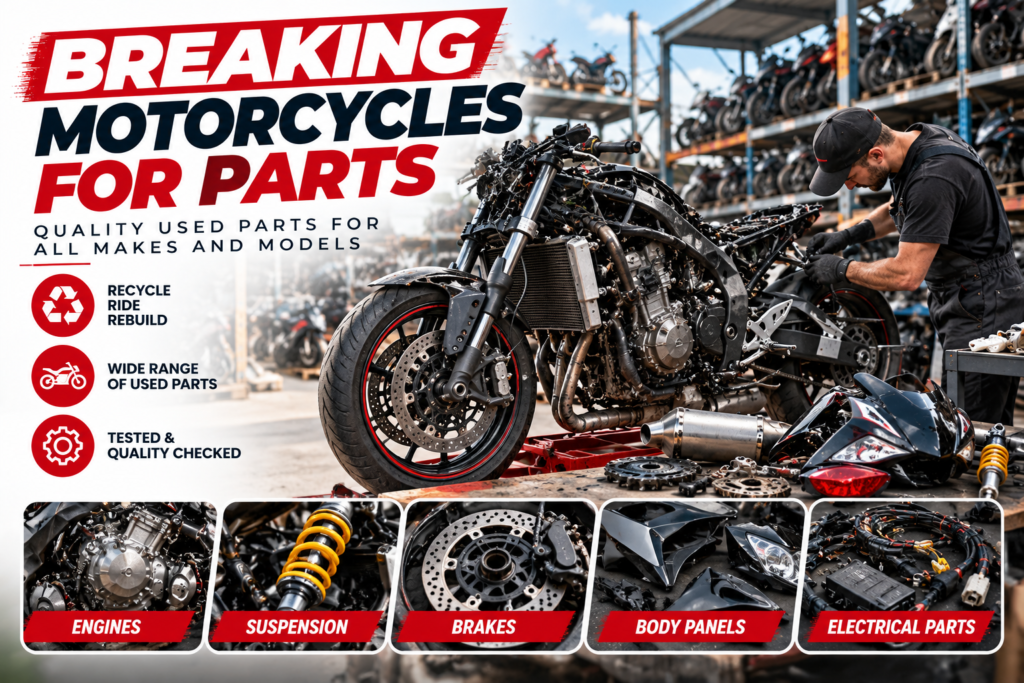
Motorcycle breakers play an important role in the UK motorcycle industry by helping riders find affordable replacement components, maintain older bikes and repair motorcycles that have suffered damage. Instead of allowing an entire motorcycle to go to waste, suitable components can be recovered, inspected and sold for reuse.
Breaking Motorcycles for Parts is the process of dismantling a motorcycle and separating its usable components for resale, reuse or appropriate recycling. It can provide a practical solution for riders who need replacement engines, gearboxes, wheels, suspension components, exhausts, bodywork and other motorcycle spares.
However, professional motorcycle dismantling involves more than simply taking a bike apart. Identifying suitable parts, checking their condition, recording compatibility information and handling the motorcycle responsibly are all important stages.
In this guide, we explain how Breaking Motorcycles for Parts works in the UK, which components can be recovered, why riders buy used motorcycle spares and what to consider when choosing a motorcycle breaker.
What Does Breaking Motorcycles for Parts Mean?
Breaking Motorcycles for Parts means dismantling a complete motorcycle so that individual components can be recovered and made available for reuse.
Motorcycles may be broken for parts for several reasons, including:
- Accident damage that makes repairing the complete bike uneconomical
- Serious mechanical problems
- Age-related wear and deterioration
- Limited availability of replacement components
- A motorcycle being purchased specifically for dismantling
- An owner deciding that restoring the complete motorcycle is not worthwhile
Even when a motorcycle cannot reasonably be returned to the road, some of its components may remain suitable for reuse.
For example, a Breaking Motorcycles for Parts with damaged bodywork may still have usable electrical components, engine covers, switches or other parts. Each component must be assessed individually rather than assuming that every part is suitable for resale.
How Do UK Breaking Motorcycles for Parts Work?
Motorcycle breakers follow a process designed to recover suitable parts while identifying components that are damaged, worn or unsuitable for reuse.
Although procedures vary between businesses, the process generally includes the following stages.
1. Sourcing Donor Motorcycles
The first step in Breaking Motorcycles for Parts is obtaining a motorcycle that can be dismantled.
A breaker may source donor bikes through legitimate salvage channels, unwanted project motorcycles, damaged motorcycles or other appropriate suppliers.
The motorcycle’s condition, age, model and availability of desirable components can influence whether dismantling is commercially worthwhile.
2. Assessing the Motorcycle
Once the motorcycle arrives, the breaker assesses its overall condition.
This may include examining the engine, frame, wheels, suspension, electrical systems, bodywork and other components.
The assessment helps identify parts that may be suitable for reuse and areas that require more careful inspection because of possible accident damage or mechanical wear.
3. Identifying Reusable Parts
Not every component on a donor motorcycle can be sold as a working replacement.
Parts must be considered individually, taking account of their condition, function and suitability for reuse.
Potentially reusable components include engines, gearboxes, wheels, fairings, exhaust systems, switchgear and selected suspension components.
Structural and safety-critical components require particular care because damage may not always be visible during a basic inspection.
4. Dismantling the Motorcycle
The motorcycle is then dismantled in a controlled and organised manner.
Careful removal helps protect components from unnecessary damage and preserves useful fittings, mounting points and connectors.
Keeping related components together can also make it easier to identify what belongs to each assembly and what will be supplied to a customer.
5. Inspecting and Testing Components
After removal, parts can be inspected for wear, corrosion, cracks, impact damage and missing components.
Some mechanical and electrical parts may require additional testing.
For example, a starter motor may be tested for operation, while a wheel may need careful assessment for damage or distortion.
Buyers should always ask what checks have actually been completed rather than assuming every used component has undergone comprehensive testing.
6. Cleaning and Cataloguing
Suitable parts may be cleaned and labelled before being stored.
A breaker may record information such as:
- Motorcycle make and model
- Model year
- Engine capacity
- Part description
- Original part number
- Condition
- Stock reference
- Included components
Accurate records make it easier to match parts to customers’ motorcycles and reduce the risk of incorrect orders.
7. Selling Parts to Customers
The final stage involves making suitable components available through online listings, telephone enquiries, parts departments or other sales channels.
Customers can provide their motorcycle details and request a compatible replacement.
Depending on the supplier, parts may be available for collection or delivery within the UK.
10 Common Parts Recovered When Breaking Motorcycles for Parts
The range of available components depends on the donor motorcycle and the results of its inspection.
1. Motorcycle Engines
Engines are among the most valuable components that may be recovered from a donor motorcycle.
A used engine can be useful when the original unit has suffered serious damage or requires extensive repairs.
Before buying, check the engine code, identification number, mileage where known, condition, testing information and included components. Confirm compatibility with the exact motorcycle model and year.
2. Gearboxes and Transmission Components
Gearboxes, selector mechanisms, clutch components and related transmission parts may be available from dismantled motorcycles.
These components can help riders repair older bikes or replace damaged transmission parts.
Because internal wear can be difficult to assess visually, ask about testing and consider professional inspection before installation.
3. Wheels and Hubs
Front wheels, rear wheels and related components can be recovered where their condition makes them suitable for reuse.
Check for cracks, bends, corrosion, damaged bearing seats and worn mounting areas. If the wheel’s history is uncertain, have it inspected by a qualified motorcycle technician.
4. Suspension Components
Motorcycle breakers may recover forks, fork legs, rear shocks, springs and suspension linkages.
These parts can be useful when repairing damaged motorcycles, but suspension directly affects handling and stability.
Look for oil leaks, bent tubes, corrosion, damaged mounts and worn components. Avoid using parts with uncertain structural integrity.
5. Exhaust Systems
Exhaust pipes, silencers and related brackets may be available from donor motorcycles.
Before purchasing, check for corrosion, cracks, dents, damaged mounting points and compatibility with your motorcycle.
Also consider whether the replacement meets applicable noise and road-use requirements.
6. Fairings and Bodywork
Fairings, mudguards, side panels, seats and other bodywork are commonly sought-after replacement parts.
Used bodywork can be particularly useful after an accident or during a restoration project.
Request photographs of the actual component and check for broken tabs, cracks, previous repairs, missing fittings and colour differences.
7. Electrical Components
Switchgear, instruments, starter motors, charging components, sensors and selected control units may be recovered during dismantling.
Electrical compatibility is important because components can differ between model years and variants.
Check part numbers, connectors and the supplier’s testing information before buying.
8. Braking Components
Depending on their condition and suitability for reuse, certain braking components may be available through motorcycle breakers.
Brakes are safety-critical, so condition should take priority over price. Components showing cracks, excessive wear, corrosion or uncertain damage should not be used.
Have questionable parts assessed professionally and follow the motorcycle manufacturer’s specifications.
9. Controls and Accessories
Handlebars, levers, footrests, mirrors, brackets and switchgear may be available from dismantled motorcycles.
These can be useful for everyday repairs and restoration work.
Confirm the correct fitment and inspect mounting points, threads and adjustment mechanisms before ordering.
10. Small Fittings and Hardware
Bolts, brackets, spacers, clips and other small fittings can be difficult to source individually.
A motorcycle breaker may be able to supply original hardware from a donor motorcycle, depending on stock.
Check the exact dimensions, specification and application, particularly where fasteners are safety-critical.
Why Do Riders Buy Parts From Motorcycle Breakers?
There are several reasons riders choose used parts instead of purchasing every component new.
Lower Repair Costs
Used components may cost less than their new equivalents, making some repairs more affordable.
However, the true saving depends on the condition of the part and any additional delivery, fitting or refurbishment costs.
Access to Genuine Parts
Breaking motorcycles for parts can make original manufacturer components available to riders who prefer to maintain their bike’s original specification.
Compatibility and condition must still be verified.
Finding Discontinued Components
Older motorcycles can become difficult to maintain when certain new parts are no longer available.
Motorcycle breakers may have suitable components from donor bikes, depending on stock.
Supporting Restoration Projects
Restoring a motorcycle often involves finding original bodywork, brackets, engine covers and other components.
Used parts can help owners complete restoration work without relying entirely on new or aftermarket replacements.
Reducing Unnecessary Waste
Recovering suitable components allows them to be reused rather than discarded with the complete motorcycle.
Materials that cannot be reused as working parts may be separated for appropriate recycling through responsible processes.
How to Choose a Reliable Motorcycle Breaker in the UK
Finding a suitable supplier is an important part of buying used motorcycle parts.
Before ordering, consider the following checks.
Check Compatibility Information
A reliable supplier should be able to discuss the motorcycle’s make, model, year and relevant part details.
Where possible, compare the original part number with the replacement.
Ask About Condition
Find out whether the part has been inspected, tested, repaired or refurbished.
Ask for details of any known defects and request clear photographs if the listing does not provide enough information.
Review Warranty and Return Terms
Policies vary between sellers. Understand the terms before purchasing, including what happens if the part is faulty, incorrectly described or incompatible.
Compare Total Costs
Consider the part price, delivery, installation and possible refurbishment.
A slightly more expensive part in better condition may provide better overall value.
Keep Purchase Records
Retain your invoice, seller details, part description and any identification information supplied with the component. These records can be useful if you need to contact the seller or document the repair.
Is Breaking Motorcycles for Parts Environmentally Friendly?
Motorcycle dismantling can support more efficient use of materials by giving suitable components another useful life.
Reusing an existing part can reduce demand for a new replacement and help prevent a serviceable component from being discarded unnecessarily.
Responsible dismantling also involves handling fluids, batteries and other waste materials appropriately and sending recyclable materials through suitable channels.
The environmental benefit depends on how the motorcycle and its components are handled. Reuse should not come at the expense of safety, and parts that are unsuitable for continued use should not be sold as serviceable replacements.
Legal and Safety Considerations for UK Motorcycle Breakers
Businesses involved in dismantling motorcycles should understand their responsibilities concerning vehicle ownership, waste handling, environmental requirements and the sale of used components.
The exact obligations depend on the activities being carried out and the circumstances of the vehicle.
Buyers should also be cautious about components with unclear origins or missing identification details. Use reputable suppliers and keep records of purchases.
When a part affects braking, steering, suspension or structural integrity, confirm its suitability before fitting. If you are unsure, seek advice from a qualified motorcycle technician.
Common Mistakes to Avoid When Buying Used Motorcycle Parts
Avoid these mistakes when buying from a motorcycle breaker:
- Choosing only by price: A low-cost component may need expensive repairs.
- Ignoring model-year differences: Similar motorcycles may use different parts.
- Skipping part-number checks: Appearance alone does not guarantee compatibility.
- Assuming every part is tested: Ask what inspection or testing has been completed.
- Overlooking missing fittings: Confirm exactly what is included.
- Ignoring return terms: Understand your options before paying.
- Taking risks with safety-critical parts: Have uncertain components professionally assessed.
- Forgetting delivery costs: Include transport when comparing suppliers.
A few extra checks can help you avoid unnecessary expense and delays.
Ready to Find Quality Used Motorcycle Parts?
Looking for affordable replacement components for your motorcycle?
Choose a reputable UK motorcycle breaker that provides clear part descriptions, accurate compatibility information and transparent condition details. Before ordering, provide your bike’s make, model, year and the part number where available.
Contact a trusted motorcycle breaker today to find suitable used parts for your repair, maintenance or restoration project. Ask about availability, condition, delivery and returns so you can make an informed decision before purchasing.
Final Thoughts: Breaking Motorcycles for Parts
Breaking Motorcycles for Parts helps UK motorcycle breakers recover usable components from damaged, unwanted or uneconomical-to-repair bikes.
The process typically involves sourcing donor motorcycles, assessing their condition, removing suitable components, inspecting and testing parts, cataloguing stock and selling compatible replacements to customers.
For riders, the benefits can include lower repair costs, access to genuine components and a way to find discontinued parts for older motorcycles.
The most important consideration is choosing the correct component in suitable condition. Check compatibility, ask about inspection and testing, compare total costs and understand the seller’s return policy.
For brakes, wheels, suspension, steering and structural components, safety must always come before savings. With careful research and a reputable supplier, used motorcycle parts can be a practical option for keeping your bike maintained and roadworthy.
FAQs About Breaking Motorcycles for Parts
What does breaking motorcycles for parts mean?
It means dismantling a motorcycle and recovering suitable components for resale, reuse or appropriate recycling.
Why do motorcycle breakers dismantle bikes?
Motorcycles may be dismantled because of accident damage, serious mechanical faults, age, high repair costs or a lack of demand for the complete vehicle.
What parts can be recovered from a motorcycle?
Depending on condition, parts may include engines, gearboxes, wheels, suspension, exhausts, bodywork, electrical components, controls and small fittings.
Are used motorcycle parts cheaper than new parts?
They are often cheaper, but prices depend on the component, condition, availability and demand. Include delivery, fitting and refurbishment costs when comparing options.
Can motorcycle breakers supply parts for older bikes?
Yes. Depending on available stock, breakers can be useful sources of original and discontinued components for older motorcycles.
How can I check whether a used part will fit?
Confirm the make, model, year, variant and part number where possible. Ask the supplier to verify compatibility before ordering.
Are parts from dismantled motorcycles reliable?
They can be suitable when properly identified and assessed, but condition varies. Ask about testing, damage, wear and any warranty or return terms.
Is it safe to buy used motorcycle engines?
A used engine can be a practical replacement, but check its engine code, condition, history, included components and compatibility. Professional inspection may be worthwhile before installation.
Can I buy used motorcycle suspension and brakes?
These components may be available, but they are safety-critical. Check their condition carefully and have uncertain parts professionally inspected before use.
Do UK motorcycle breakers deliver parts?
Many suppliers offer delivery or collection options, but availability, packaging and costs vary. Confirm the arrangements before purchasing.
Does motorcycle dismantling help reduce waste?
Yes. Recovering suitable components for reuse and sending appropriate materials for recycling can reduce unnecessary waste.
What should I ask a motorcycle breaker before buying?
Ask about compatibility, condition, testing, previous damage, included fittings, delivery, returns and any warranty.